Choosing 400G Optics for 10km to 80km Fiber Links: LR4, ER4 and Coherent ZR
Compare 400G LR4, ER4 and coherent ZR for 10km, 40km and 80km links by checking optical budget, host support, FEC, power and cooling.

AXONODE / NETWORK FIELD NOTES
Choosing 400G Optics for 10km to 80km Fiber Links: LR4, ER4 and Coherent ZR
A request covering 10km, 40km and 80km may look like a simple optics quotation. In practice, those three distances can call for very different decisions.
A 400G upgrade often starts with a list of links. One connects a nearby aggregation site. Another runs between towns. The longest reaches a regional hub. All three need 400GbE, so it is tempting to pick LR4, ER4 and ZR from a catalog and move on to pricing.
The trouble is that distance alone does not identify the right optical interface. At 10km, the question may be whether the module and the far-end port agree on the same LR4 specification. At 40km, it is whether the actual fiber route leaves enough optical margin. At 80km, the conversation may shift to optical amplification, coherent signal quality and router support.
Before quoting, we would look at each route separately.
10 kmWhat LR4 actually means at 10km
For a conventional duplex single-mode connection, 400G LR4 is a sensible starting point. A typical four-wavelength LR4 design carries 400GbE over two fibers using four 100G PAM4 optical lanes. It can be a relatively straightforward choice for connecting a central office to a nearby aggregation location, provided the installed hosts support the interface.
The naming needs a closer look, though. IEEE 400GBASE-LR4-6 specifies 6km, while the 100G Lambda MSA 400G-LR4-10 specification covers 10km. Some vendors shorten both descriptions to “400G LR4.” Cisco, for example, documents a 10km QSFP-DD LR4 optic that meets the IEEE 6km requirement and extends the reach under the MSA specification.
That does not make the names interchangeable in every quotation. Ask for the actual optical specification, the wavelength/lane arrangement and the expected FEC mode. An older eight-wavelength 400G LR8 design may also be rated for 10km, but sharing a reach rating does not make LR8 and LR4 optical peers.
There is also a more ordinary problem: the route on the drawing may not be the route in the ground. A site shown as 9km away can have more fiber length once the cable follows roads, utility rights-of-way, slack loops and intermediate distribution points. Use documented fiber length and measured loss, not the distance between two map pins.
40 kmThe last few decibels count at 40km
At roughly 40km, the decision becomes less forgiving. Fiber attenuation, splice history, patch panels and engineering reserve all start to matter. A route that looks acceptable from its length may still be a poor match for a particular module.
There is a standards detail worth knowing before comparing offers. The 100G Lambda MSA defines 400G-ER4-30 for 30km, while the IEEE-defined 40km Ethernet interface is 400GBASE-ER8, which uses eight optical wavelengths. Vendors also offer four-wavelength 400G ER4 modules rated for up to 40km, including an Axonode QSFP-DD ER4 option. These need to be assessed against their own published optical specifications; “40km ER4” is not automatically equivalent to IEEE ER8 or another supplier's ER4 module.
Consider an illustrative 39km fiber route. If its measured attenuation averaged 0.34dB/km, the fiber itself would account for 13.26dB of loss. Four connector pairs at 0.35dB each would add 1.4dB, and ten splices at 0.1dB each another 1.0dB. The total is 15.66dB before any engineering margin.
Those figures are an example, not field measurements or a claim that a specific ER4 optic will close the link. The actual result may be better or worse. It must be checked against the chosen module's transmitter and receiver limits, relevant optical penalties, FEC requirements and the operator's reserve policy. On a short, low-loss route, receiver overload can be a concern as well; longer reach is not always a harmless substitute.
This is why a 40km quotation is more useful when it comes with an OTDR record or measured end-to-end loss. An optics part number by itself tells only part of the story.
For a closer look at the evidence worth collecting before rollout, see our note on 400G ER4 field validation over 39.9km.
80 kmAt 80km, the optical design changes
An 80km 400G link is not simply a 40km ER4 link with a stronger laser.
This is where coherent ZR enters the discussion. Conventional LR4 and ER4 client optics use intensity-modulated, direct-detection optical signals across several wavelengths. 400ZR uses coherent detection and digital signal processing to carry a 400GbE service over a tunable DWDM wavelength. It is a different optical interface, and it cannot be connected directly to an LR4 or ER4 receiver at the far end.
It is important to distinguish an 80km design target from a promise that an unamplified 80km fiber pair will always work. The OIF 400ZR Implementation Agreement defines an amplified point-to-point application targeting at least 80km, where optical signal-to-noise ratio (OSNR) is a key constraint. It also defines an unamplified, loss-limited application with an 11dB reference loss budget minus link impairments.
To put that in perspective, a hypothetical 80km span at 0.20dB/km would already have about 16dB of fiber attenuation, before adding connectors, splices or other losses. That alone is more than the reference budget for the OIF unamplified mode. An 80km ZR design therefore needs a real span calculation and a clear answer about amplification and operating mode. Product-specific extended-reach solutions may differ, but the reach label is not evidence on its own.
Coherent also brings a different set of host questions: supported QSFP-DD or OSFP variant, module power and cooling, system software, coherent application mode, FEC, wavelength tuning and, when a line system is involved, its channel and amplifier design. Cisco's 400ZR/ZR+ data sheet, for instance, gives different amplified and unamplified reaches. ZR and OpenZR+ should not be treated as identical just because both are called coherent optics.
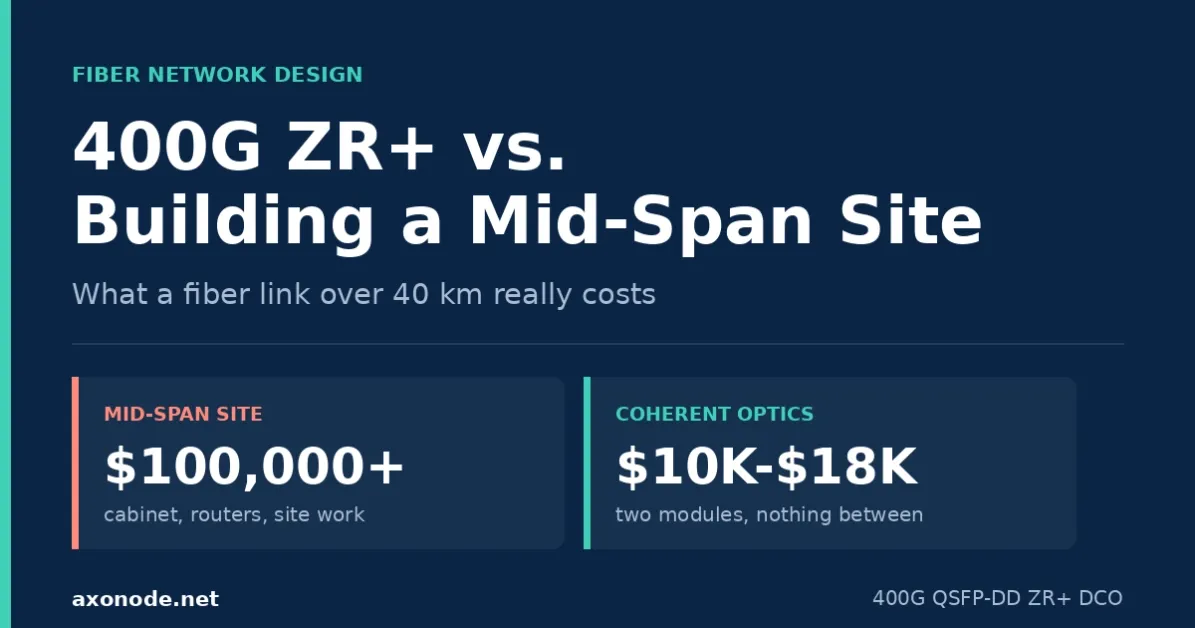
If the network already has a DWDM line system, that may shape the decision. If it does not, the cost and operational trade-offs of a new optical line design need to be considered. A longer span can also make a mid-span site an alternative worth pricing. We covered that separate design question in 400G ZR+ vs. a Mid-Span Site.
What we'd want to know before quoting all three
When a customer sends us a range of distances, the most useful response is usually a short exchange about the network, not three prices pulled from three product pages.
We would want the router or switch model at both ends, port type, software release and any existing optics part numbers. We'd ask whether the fiber is a clean point-to-point pair or passes through patch panels, filters or an optical line system. For each route, the measured fiber length and loss are more useful than an approximate kilometer figure. For coherent links, the amplification plan and intended ZR operating mode need to be explicit.
The installation environment can change the answer too. A central office with engineered airflow is different from a remote enclosure with limited cooling. Even if the optical calculation works, the host may not permit a particular module power class or port arrangement. We discussed that issue separately in 400G Optics in Outdoor Cabinets.
One final question is easy to skip: what optics are already installed at the other end? For a replacement or partial upgrade, the existing transceiver may determine what is actually interoperable. Fiber type and connector shape cannot confirm compatibility on their own; optical lane structure, modulation, FEC and the host's supported configuration have to match.
Choose the link, then the module
For a well-characterized 10km duplex fiber pair, four-wavelength LR4 may be the simplest place to start. At 40km, an engineered ER4 option can make sense, but the measured optical budget and exact interface specification have to support it. Near 80km, coherent ZR may be the right technology, with the line-system and host requirements understood from the outset.
The practical order is fiber route, optical interface, host compatibility, then quotation. That tends to produce a shorter shortlist and fewer surprises during installation.
If you're planning a mix of 400G links, send the platform models, port details, fiber measurements and intended reach for each route. Axonode can help review the requirements and narrow the options before you commit to a batch of optics.