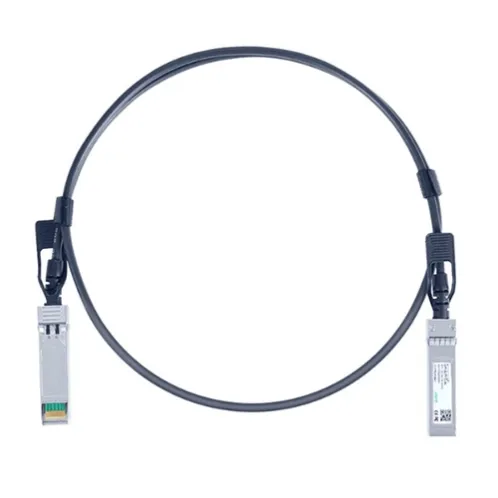
10G SFP+ Passive DAC Cable, 1m, 30AWG
One-meter passive 30AWG SFP+ direct-attach copper cable for short 10GbE and 10G Fibre Channel links between two SFP+ ports.
10G SFP+ to SFP+ · Passive twinax · 1m · 30AWG
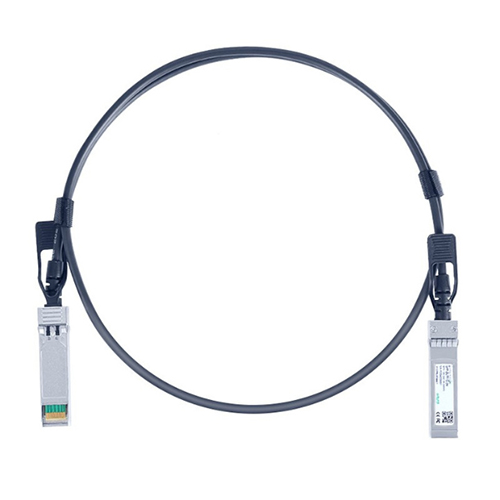
A fixed-length passive direct-attach copper (DAC) assembly for very short links between two SFP+ ports. The image represents the DAC type; the ordered length, wire gauge, labels and endpoint coding follow the approved quotation.
Deployment fit
Use it for
In-rack or adjacent-device links between switches, servers, storage or network appliances.
Endpoints
Straight SFP+ to SFP+ cable assembly; no breakout branches.
Confirm first
Both host models, software, port speed, passive-DAC support, cable routing, quantity and coding requirement.
Technical specifications
| Product type | Passive SFP+ direct-attach copper cable |
|---|---|
| Endpoint A / B | SFP+ / SFP+ |
| Topology | Straight, 1:1 |
| Cable length | 1m |
| Wire gauge | 30AWG |
| Supported line rate | Up to 10.5Gbps |
| Backward data-rate evidence | Supports operation down to 1Gbps; host support still required |
| Applications | 10 Gigabit Ethernet and 10G Fibre Channel |
| Operating case temperature | 0 to +70°C |
| Storage temperature | -40 to +85°C |
| Form-factor reference | SFP+ MSA |
| LOS / TX_DISABLE note | Passive cable assembly does not support LOS or TX_DISABLE |
| Public SKU | Omitted pending resolution of the 1m public-SKU identity collision |
Representative type image. Final length, AWG, labels and endpoint coding follow the approved quotation.
Pre-order engineering checks
- Confirm both endpoints are SFP+ ports and that both exact devices support a passive DAC at the intended speed.
- Check the real routing path, bend allowance and strain relief before locking the 1m length.
- Provide both host models and software so endpoint coding and cable acceptance can be reviewed separately.
- Do not expect optical-power readings, LOS or transmitter-disable behavior from a passive copper assembly.
Compatibility and validation
SFP+ form factor alone does not prove passive-DAC support. Confirm both host platforms, port mode and software. A cable may be accepted at one endpoint and rejected at the other if coding or platform policy differs.
Frequently asked questions
Is this cable passive or active?
This exact page covers a passive 1m SFP+ DAC using 30AWG twinax. It does not contain active signal-conditioning electronics.
Will it work in any two SFP+ ports?
No. Both device models, software versions and port modes must support passive SFP+ DAC cables. Confirm each endpoint rather than assuming form-factor compatibility.
Is 1m long enough for my rack?
Measure the actual routed path, including vertical and horizontal cable management, bend allowance and service loops. Do not select length from straight-line device spacing alone.
Can this 10G DAC run at 1Gb/s?
The approved cable source states backward data-rate support to 1Gbps, but both hosts must support that port speed and accept the cable coding. Validate the exact devices before ordering.
Does a passive DAC provide DDM or optical-power readings?
No optical path exists, so optical transmit and receive power readings do not apply. The approved source also notes that passive assemblies do not support LOS or TX_DISABLE.
Is FEC required for this 10G cable?
Do not assume a universal setting. Confirm the intended port speed, protocol and both host configurations. If the platform exposes a FEC option, use the device-supported setting for that link.
What should I check if the link stays down?
Check cable seating, both endpoint models, port speed and mode, software support, coding acceptance and interface alarms. Test the same cable on known-supported ports before treating it as a signal-loss problem.
What is needed for compatibility coding and quotation?
Send both host models, software versions, port identifiers and speed, required coding or OEM part reference, measured routing length, quantity and required date.
Validate both SFP+ endpoints before ordering
Send both host models and software versions, port speed and mode, required coding or OEM part reference, actual routed length, quantity and required date.
Request a configuration reviewFinal specifications follow the approved quotation and product datasheet.