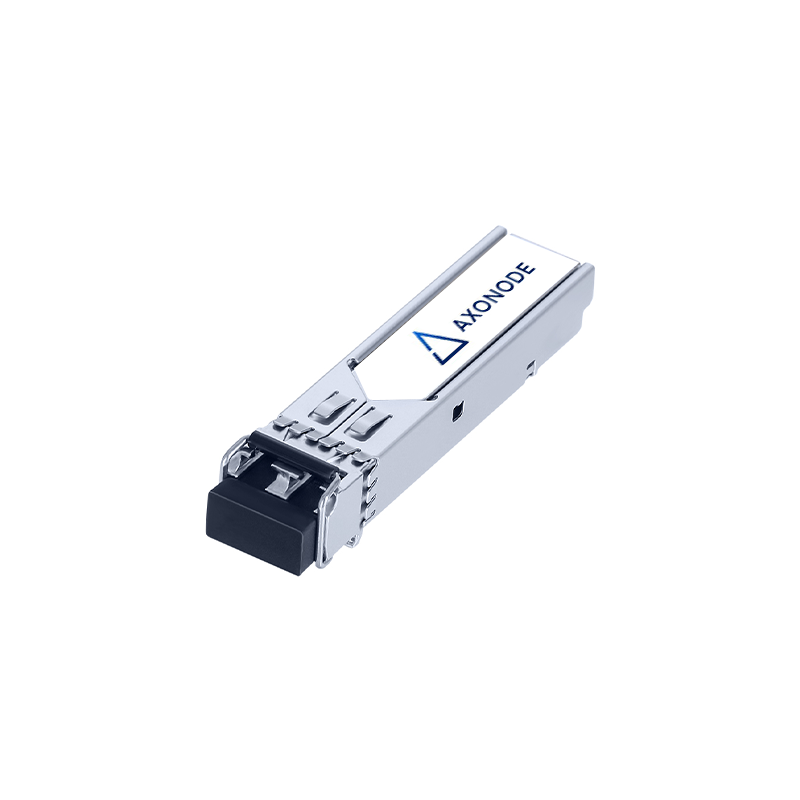
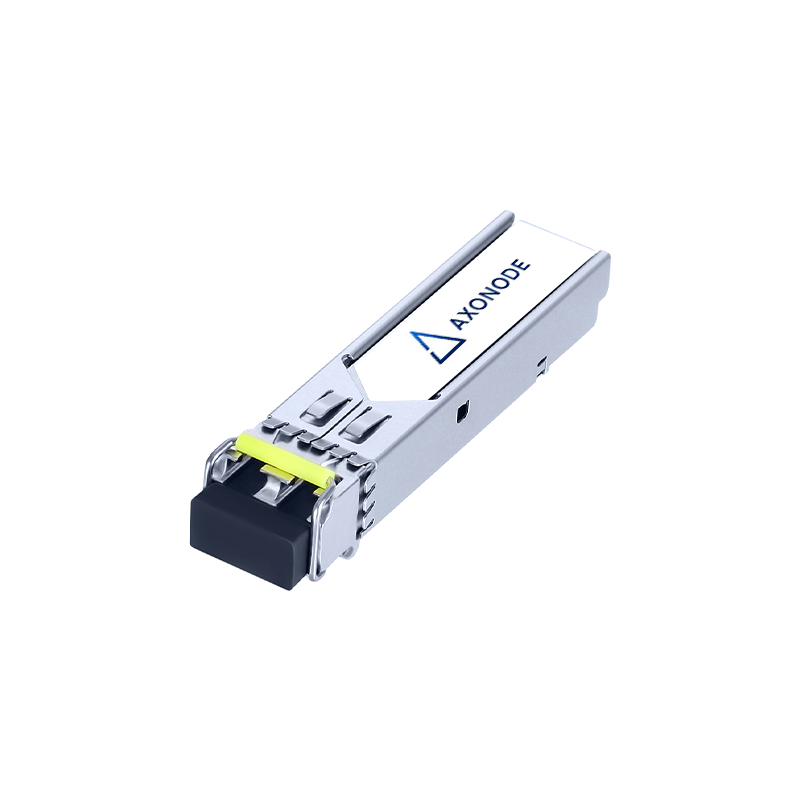
1G ZR SFP 80km Optical Transceiver
1G ZR SFP optical transceiver for 1.25Gbps single-mode links up to 80km, with a 1550nm DFB transmitter, duplex LC interface and optional DDM/DOM.
Specifications
- Warranty
- 3-Years
- Customization
- Free OEM labeling
- Delivery Time
- 48 hours dispatch
1. Plan the long-reach single-mode link first.
The Axonode 1G ZR SFP 80km transceiver supports data rates up to 1.25Gbps over a duplex single-mode fiber link. Confirm the complete fiber route, duplex LC patching, host port mode and end-to-end optical loss before deployment.
1G SFP Port
Confirm that the host device supports a 1G SFP port and the required compatibility coding.
Duplex LC / OS2 SMF
Use a two-fiber duplex LC connection over compatible 9/125µm single-mode fiber.
Reach Up to 80km
Verify total fiber attenuation, connector and splice losses, receiver limits and engineering margin for the actual route.
2. Optical specifications
| Product Type | 1G ZR SFP Optical Transceiver |
| Data Rate | 0.1 to 1.25Gbps |
| Form Factor | SFP |
| Maximum Reach | Up to 80km |
| Fiber / Connector | Single-mode fiber / Duplex LC |
| Wavelength | 1550nm; 1530–1570nm range |
| Transmitter / Receiver | DFB laser / PIN photodetector |
| Average Output Power | 0 to +5dBm |
| Receiver Sensitivity | −26dBm |
| Receiver Overload | −1dBm |
| Extinction Ratio | 9dB minimum |
| SMSR | 30dB minimum |
| Power Supply | 3.3V nominal; 3.135–3.465V; 300mA maximum |
| DDM / DOM | Available with DDM/DOM; non-DDM variants are also available |
| Operating Temperature | Commercial: 0 to +70°C; Industrial: −40 to +85°C |
| Compliance | SFP MSA and SFF-8472 |
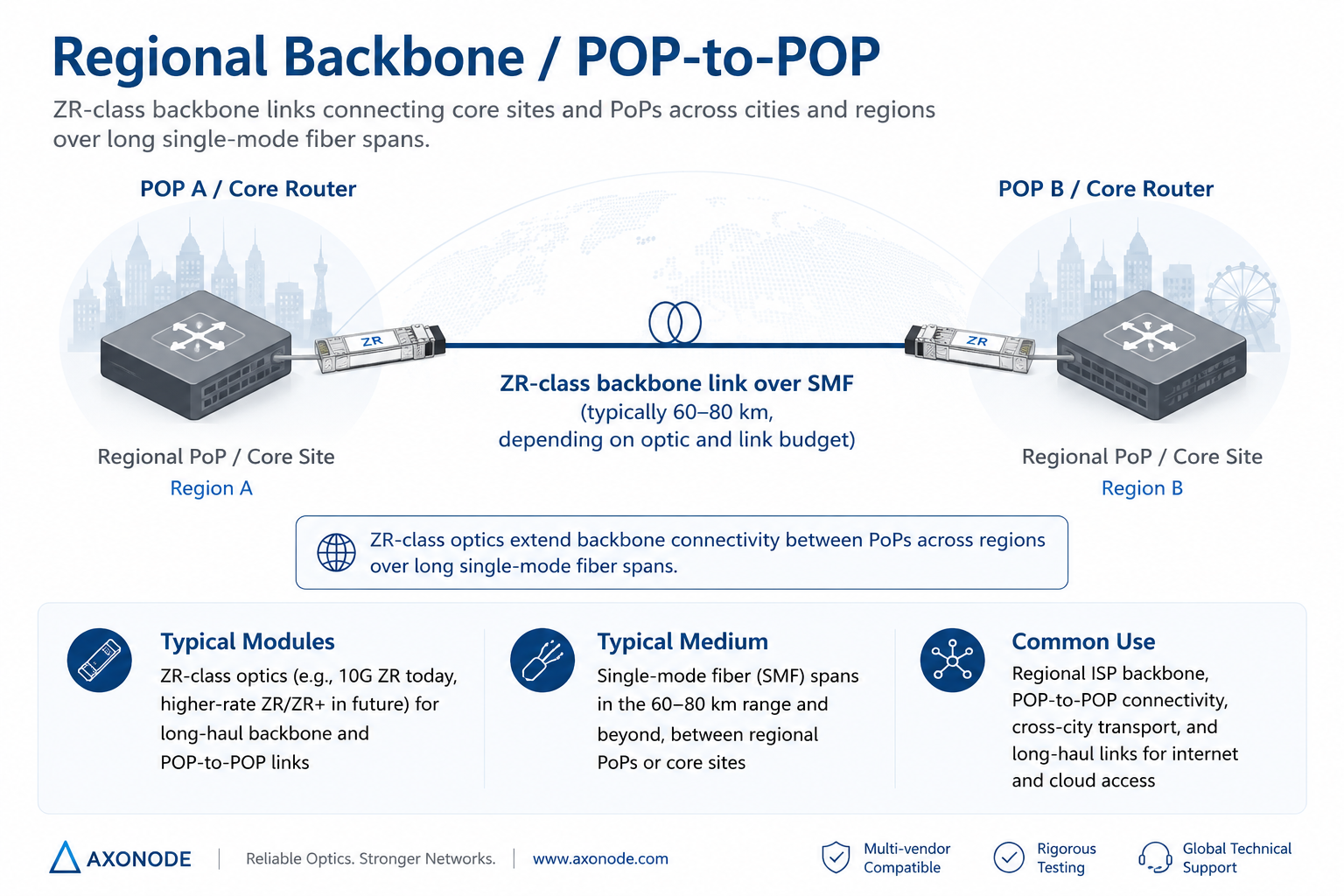
3. Regional backbone and POP-to-POP deployment
This 1G ZR SFP is intended for long-reach duplex single-mode fiber connections between regional points of presence, aggregation sites and remote network nodes. An 80km rating does not by itself guarantee a working link; verify total fiber attenuation, connector and splice losses, transmitter output, receiver sensitivity, receiver overload risk and engineering margin before deployment.
4. Compatibility prepared for your network
Compatibility coding must be confirmed for the actual switch, server adapter or router. Share the equipment brand, exact model, software or firmware environment, port mode and DDM requirements before ordering.
5. Quality and compliance
The module uses the SFP electrical and mechanical interface and supports SFF-8472 digital diagnostics on DDM variants. Standards compliance does not by itself prove host-platform compatibility.
6. Commissioning checks
Before service handover, verify connector cleanliness and polarity, host recognition, transmit and receive power, temperature, supply voltage and bias current where DDM is enabled. Retain the readings from both ends as a troubleshooting baseline.
Frequently Asked Questions
Can this 1G 80km SFP reliably support a full 80km route on my actual fiber plant?
The module is specified for up to 80km over single-mode fiber, but actual reach depends on the total 1550nm route loss. Include fiber attenuation, patch panels, connectors, splices and engineering margin, then confirm that received power remains within the −26 to −1dBm receiver range at both ends. Distance alone is not sufficient.
How should I calculate the optical budget and engineering margin for this 80km link?
Using the worst-case minimum transmit power of 0dBm and receiver sensitivity of −26dBm gives a derived gross difference of 26dB before margin; it is not a guaranteed usable channel-loss allowance. Subtract fiber, connector, splice and passive-component losses plus temperature, aging and engineering margin, and confirm that the receiver also remains below its −1dBm overload limit.
Can I use this 80km optic on a shorter or unusually low-loss link?
Only when received power remains below the −1dBm overload limit. Because transmit power can be as high as +5dBm, a low-loss route may require an optical attenuator. Size attenuation from the measured or calculated route loss and actual transmit and receive readings rather than applying a fixed value.
What should be checked at both ends before first light?
Confirm 1G port mode and host coding, inspect and clean both duplex LC connections, verify transmit-to-receive polarity, and check that the two modules use compatible wavelengths and link conditions. After the link is enabled, review receive power at both ends before carrying production traffic.
What must be confirmed for Cisco, Juniper, Arista, MikroTik or another host platform?
Confirm the exact switch, router or line-card model, software or firmware version, SFP port mode, accepted EEPROM coding, third-party optic policy and DDM support. Mechanical fit and SFP MSA compliance do not prove host acceptance. Axonode can prepare the coding profile after the exact host information is supplied.
Which DDM readings should I record when commissioning the link?
For a DDM-equipped variant, record transmit power, receive power, module temperature, supply voltage and laser bias current at both ends. Compare receive power with the −26dBm sensitivity and −1dBm overload limits, and keep the readings as a baseline. DDM helps diagnosis but does not replace an optical loss test.
Why can a route shorter than 80km still flap or accumulate CRC errors?
Distance does not identify the cause. Check whether receive power is near sensitivity or overload, inspect and clean connectors, verify duplex polarity, review bends, splices and patch-panel loss, compare both ends' DDM readings, and confirm host coding and port mode before replacing the optic.
Will this module work with the existing single-mode fiber and LC patch panels on my route?
The optical interface is duplex LC over single-mode fiber, but the installed route still needs verification. Confirm the actual fiber type, adapter and connector polish, inspect and clean every end face, avoid directly mating different polish types, and verify correct two-fiber polarity.
Which version should I choose for a remote POP or outdoor cabinet?
Commercial 0 to +70°C and industrial −40 to +85°C options are available, with or without DDM. Select the version from the expected module case temperature and monitoring requirement; an outdoor-cabinet label alone is not enough to determine the correct temperature grade.
What information should I send Axonode for an 80km link review or RFQ?
Provide the actual route length or measured loss, fiber and patching details, connector and splice count, exact device and port models, software version, temperature range, DDM requirement, coding target and quantity. These details allow the optical configuration and compatibility requirements to be reviewed without assuming that distance alone defines the link.
Downloads
The 1G ZR SFP 80km technical datasheet is available on request. Share the host device model and complete fiber-route information so the correct technical file can be supplied.
Request the 1G ZR 80km datasheet
Confirm your 1G 80km single-mode link
Share your device model, fiber distance, estimated route loss, connector and splice count, temperature requirement and quantity. Axonode will help review the coding profile and optical configuration before ordering.
Request an 80km Link Review